8 Facebook Competition Rules You Should Never Ignore
Learn how to run a successful Facebook contest by following Facebook's competition rules and guidelines. Increase brand exposure and engagement.
Updated: October 29, 2026
With around 3 billion monthly users, Facebook is still the world’s largest social network. However, tricky ever-changing algorithms can make it difficult to reach people on the sprawling network.
Contests and giveaways can change that. They spark excitement about your brand and put it in front of people who may otherwise never see you.
But there’s a catch: Facebook’s parent company, Meta, has its own rules for promotions, and they’re stricter than many marketers realize. Plenty of popular giveaway formats, like “like, share and tag a friend to win,” actually break them. Break the rules and your post could be removed, or your Page could be restricted.
Meta’s promotion rules live in two places: the Promotions section of its Policies for Pages, Groups and Events, and its spam policy, which covers Facebook, Instagram, Messenger and Threads. Meta updates these from time to time, so go over this list – and check Meta’s policy pages – before you launch your next contest.
1. Provide detailed contest rules
Meta makes you responsible for running your promotion lawfully. That includes the official rules, the offer terms and the eligibility requirements, such as age and residency. It also includes any registration or approval your prize needs where you run the promotion. Put your rules on an easily accessible landing page and link to them from every post. Some important things to cover include:
- Who is running the contest, including the sponsor’s name and address.
- Who is eligible to enter (age, location and any exclusions, such as employees).
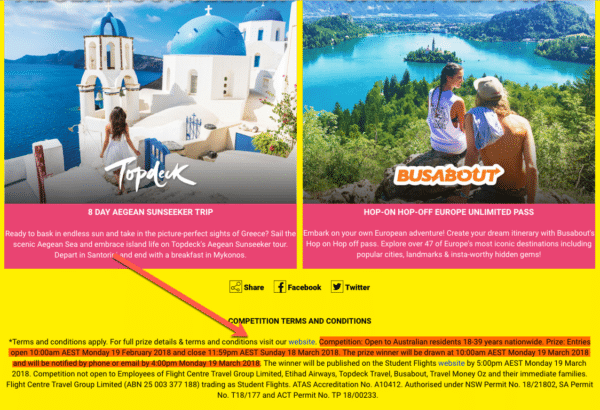
An example of a contest that clearly states the start and end date.
- Tell when and how a winner will be chosen by spelling out the judging criteria for the contest.
- Tell who is running or administering the competition.
- Clearly describe the prizes. This is important since many territories require clear descriptions of prizes.
Here is an example
of a set of contest terms that goes to great lengths to describe the prizes:
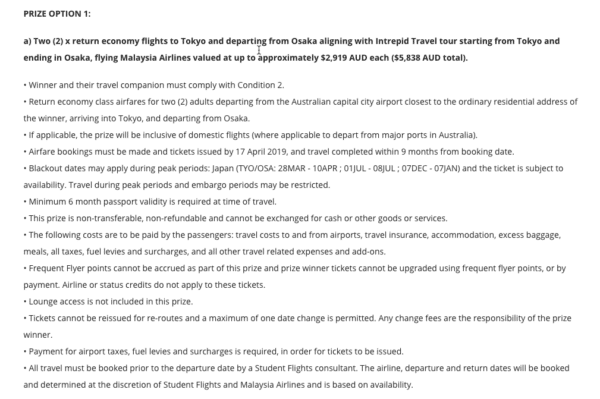
Contest terms that outline the prizes in detail.
- Include a release that allows you to use any user-generated content that is needed for the contest, as well as a release for any publicity rights.
- State that the competition is void where prohibited.
For more information, check out our Facebook and Instagram Contest Rules Template.
2. Make it clear that Meta is not your sponsor
Every promotion on Facebook must include two statements. First, each entrant must acknowledge that the promotion is not sponsored, endorsed or administered by, or associated with, Meta. Second, each entrant must fully release Meta from liability. Running the contest on Instagram too? Include the same statements naming Instagram.
The easiest way to handle this is to add both statements to your official rules, and a short version (“This promotion is not sponsored, endorsed or administered by, or associated with, Meta”) to your contest post.
3. Never run a contest from a personal profile
According to Meta’s rules, you can only run a promotion from a Facebook Page, Group or Event. Personal timelines and friend connections can’t be used to administer promotions. If you’ve accidentally been using a personal profile for your business instead of an official Facebook Page, straighten this out before running your contest.
4. Don’t require – or reward – shares, reposts or tags
We’ve all seen Facebook contests where you must share a post or tag three friends to win. What many will be surprised to learn is that these contests break Meta’s rules. The policy says a promotion must not “require or incentivize participants to share, repost, tag others” or otherwise publicize it.
Notice the word “incentivize.” This doesn’t just mean you can’t make sharing or tagging a condition of entry. You also can’t offer bonus entries for it. “Tag a friend for an extra entry” is off-limits, too.
The good news: you can still reward people for spreading the word, as long as it happens off Facebook. For example, ShortStack’s Refer-a-Friend feature gives entrants a personal referral link and awards bonus entries when a friend actually enters through it. The reward is for the friend’s entry, not for the share itself.
5. Don’t trade entries for likes or follows
This one catches a lot of marketers out. Meta’s spam policy doesn’t allow offering anything in exchange for engagement, such as likes, follows or shares – and that includes chances to win a giveaway. So “Like our Page to enter” and “Follow us for a bonus entry” are both out, on Facebook and Instagram.
So what can you ask people to do? Commenting on your post is allowed, which is why comment-to-win giveaways are so popular. You can also invite people to follow your Page – just don’t make it a requirement or give them entries for it. Here’s a quick cheat sheet:
Entry action | Allowed on Facebook? |
|---|---|
Comment on your post | Yes |
Enter through a form on your landing page or website | Yes |
Share or repost your promotion | No – not to enter, and not for extra entries |
Tag friends | No – not to enter, and not for extra entries |
Like or react to your post | No – not to enter, and not for extra entries |
Like or follow your Page | No – not to enter, and not for extra entries |
TIP: Running a comment-to-win giveaway? ShortStack can import the comments from your post so you can pick a winner fairly. Want to send people to a full contest page instead? Publish your campaign as a landing page or embed it on your website, then share the link in your post.
6. Know the difference between a sweepstakes, a contest and a lottery
Meta doesn’t write your contest’s legal structure for you – it simply requires your promotion to follow the law. And in the US, the law draws a hard line between three types of promotions:
- Sweepstakes: Winners are chosen by chance, like a random drawing. These are allowed, as long as no purchase is required to enter.
- Contests: Winners are chosen based on skill or merit, such as the best photo or recipe, judged by the sponsor or its agents. These are allowed too.
- Lotteries: A promotion that combines a prize, chance and “consideration” is an illegal lottery for most businesses. Consideration, legally speaking, means having to give something of value – usually a purchase – in exchange for an entry.
That’s why sweepstakes say “No purchase necessary.” If you want to give bonus entries to customers who buy something, you’ll need to offer a free way to enter with equal odds. Keep in mind that rules vary from country to country (and from state to state), so if your contest is open internationally, check the laws everywhere it’s available.
7. Get explicit permission to use submitted content
If you’re running a contest where entrants submit photos, videos or other content, make sure they agree to let you use it. User-generated content (UGC) can be an extremely valuable asset for a business. It can generate interest in a contest and help raise awareness of your brand. Entries from previous contests can even be used in future promotions – but only if you have permission from the people who submitted them.
The simplest approach is to spell out exactly how you might use entries in your official rules, then add a required checkbox to your entry form so entrants actively agree. Additionally, if you plan to announce the winner publicly, include publicity rights in your rules so the winner has given permission.
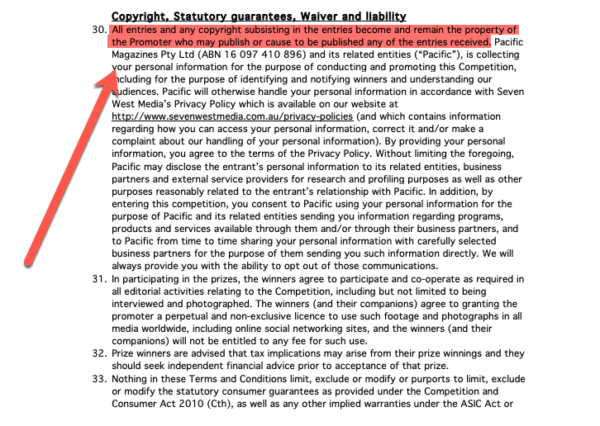
Contest Terms outlining the rights to re-use content.
8. Understand that you’re on your own
The last rule in Meta’s promotion policy is simple: Meta won’t help administer your promotion, and if you run one on its platforms, you do so at your own risk. If your contest runs afoul of Meta’s rules or the law, Meta isn’t going to step in – and the consequences, from deleted posts to legal trouble, are yours to deal with.
Conclusion
Following the rules when running a Facebook contest takes a bit of extra time and consideration. It can mean jumping through a few more hoops than just posting some images and a giveaway on your Page. But by sticking to Meta’s promotion rules, you reduce the chance that your post will be removed or your Page restricted.
And you don’t have to give up on reach to stay compliant. A comment-to-win post, a landing page with a referral link, or a contest that people genuinely want to share because they’re excited about the prize will all get you the exposure you’re after – without putting your Page at risk.
Create a Facebook contest to generate leads and sales. Get Started Today. No credit card required.
Create a Facebook contest to generate leads and sales. Free.
Get Started Today. No credit card required. Risk-free.