Running a Giveaway? Why “No Purchase Necessary” is Necessary
Learn about the "no purchase necessary" law for giveaways and how it applies to different types of organizations.

Updated: November 9, 2026
If you’re new to running giveaways for your business, you may have never given the phrase “no purchase necessary” much thought until now. After all, asking for a payment or purchase to enter your giveaway is tempting, especially if you’re ponying up a really juicy prize. But whether you’re giving away a t-shirt or a new Range Rover, there’s a reason “no purchase necessary” is attached to every sweepstakes - it’s the law.
Before we get into talking more about legal things, here’s a small disclaimer: I’m not a lawyer. But with nine years of experience helping others to build and execute successful giveaways, and with the help of a few legal resources, I’ll show you how to navigate the No Purchase Necessary law so you know how it applies to you and how you can keep your business safely in compliance.
What "the law" actually is
There's no single statute called the No Purchase Necessary law. The rule comes from lottery laws: federal laws that bar promoting lotteries by mail and broadcast, plus a lottery ban in nearly every state. The FTC, FCC, and U.S. Postal Service each play a role, but state attorneys general do most of the enforcing.
A promotion is an illegal lottery when it has all three of these elements:
- Prize: something of value is awarded.
- Chance: winners are picked at random.
- Consideration: entrants must pay money or give something else of value to enter.
Remove any one of the three and you're no longer running a lottery. Since a giveaway needs a prize, businesses remove either chance (a skill contest) or consideration (a free sweepstakes).
"Consideration" is broader than cash. Depending on the state, it can include a purchase from a partner or sponsor, or requiring significant time or effort to enter. Clicking "like" or filling out a short form generally isn't consideration, but rules differ by state, so check before you launch.
Lotteries, sweepstakes, contests, and raffles
Type | How winners are picked | Can you charge to enter? | Who can run it |
|---|---|---|---|
Lottery | Chance | Yes | Government only (state lotteries) |
Sweepstakes | Chance | No, a free entry method is required | Any business |
Contest | Skill (judged entries, votes, quiz scores) | Often yes, but some states restrict it | Any business |
Raffle | Chance | Yes | Generally nonprofits only, under state charitable gaming rules |
Sweepstakes are the most common giveaway: random drawing, free to enter. Contests pick winners by skill, like a photo contest judged against published criteria. Because there's no chance involved, they aren't lotteries, but you need clear, objective judging criteria. Raffles are off-limits to for-profit businesses.
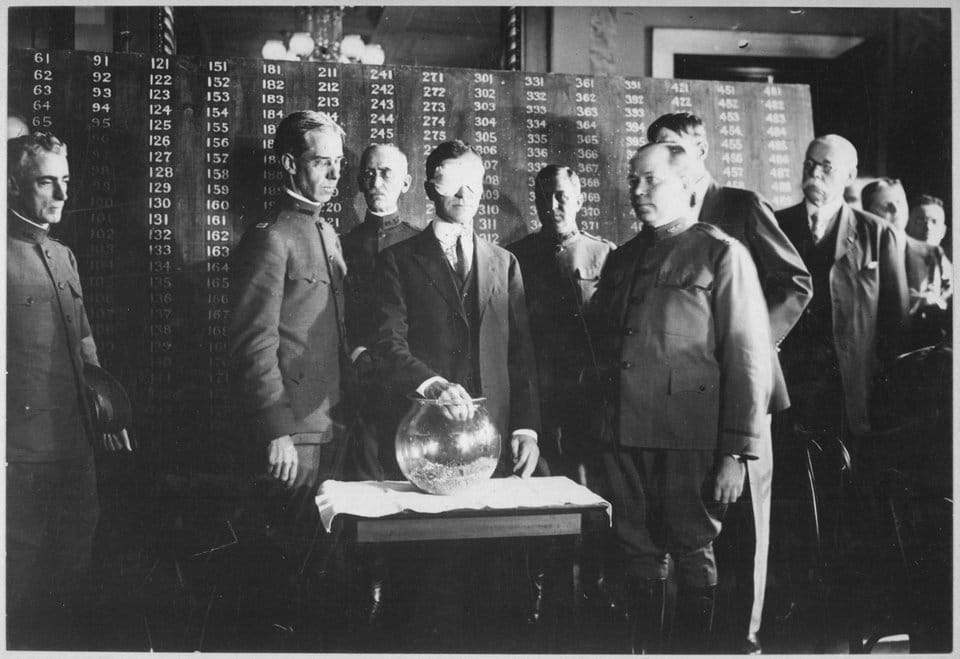
Secretary of War Newton D. Baker, blindfolded, drawing the first draft numbers in the lottery to be called up to serve in the American forces during world War I, 20th July 1917
When and to whom does the law apply?
If you live within the US, the No Purchase Necessary law applies to you, whether you’re running a giveaway for a tiny mom and pop shop or a major national brand. When awarding a prize by chance, different laws apply to different types of organizations. Here’s a breakdown of the differences of each:
Lotteries: If you’ve been paying attention so far, you’ll know that, unless you’re a government entity, hosting a lottery is a big no-no. A giveaway is considered a lottery when:
- the giveaway offers one or more prizes of value,
- the winners of the giveaway are chosen at random,
and - the entry requires a payment of money or other consideration.
The word “consideration” is used loosely to cover anything that is directly or indirectly of value to the company, monetary or otherwise. For example, you can’t require a purchase be made with a sister company or sponsor in exchange for an entry. What some states deem “consideration” differs from others, so make sure you check with local laws to stay in compliance. We’ve listed a few individual state laws here.

Sweepstakes: What makes a sweepstakes different from a lottery is the exchange of purchase or consideration. A sweepstakes must be free to enter. You may be thinking “but don’t I have to buy french fries to play McDonald’s Monopoly game?” And the surprising answer is, you don’t! We’ll talk more about that later on.

Raffles: Raffles are giveaways in which participants can purchase tickets to participate. Also similar to a lottery, the more tickets purchased in a raffle, the better odds of winning. However, if you’re a for-profit business, raffles are strictly off-limits. They’re only legal when non-profit organizations use them as a means to raise money.
"But I see giveaways that require a purchase all the time"
Think bottle-cap codes, scratch-offs, or game pieces on fast-food fries. They look purchase-only, but read the fine print: each one offers an Alternative Method of Entry (AMOE), a free way to enter. McDonald's Monopoly, for example, has long let people request free game pieces by mailing in a handwritten, self-addressed stamped envelope.
An AMOE only works if it follows a few rules:
- Equal dignity. Free entrants get the same odds and the same prizes as buyers. A purchase can't boost your chances.
- Clearly disclosed. Ads and official rules should say "No purchase necessary. A purchase will not increase your chances of winning," and explain how to enter for free.
- Not burdensome. A mail-in or online form is fine. A free method designed so no one uses it isn't.
Big brands have legal teams to manage these details. For most businesses, the simplest path is a giveaway that's free for everyone, backed by clear official rules. Our Free Rules Generator is a good place to start.
Your giveaway compliance checklist
- No purchase or payment required to enter, or a free AMOE with equal odds.
- "No purchase necessary" stated in your rules and promotional materials.
- Official rules published, covering eligibility, entry dates, how winners are picked, prize details and retail value, odds, and sponsor contact info.
- Eligibility set. Age minimums, and which states or countries can enter. Laws outside the U.S. differ, so many brands limit entry to U.S. residents.
- Registration and bonding checked. If total prize value tops $5,000 and New York or Florida residents can enter, you must register and post a bond: 30 days before launch in New York, 7 days in Florida.
- Platform rules followed. Meta's promotion guidelines, for example, don't allow "share on your timeline to enter" or tagging friends in a post to enter, and require a release stating the promotion isn't affiliated with Meta.
- Prize taxes planned. In the U.S., prizes worth $600 or more generally need a 1099 to the winner.
Registration and bonding: see Klein Moynihan Turco and Thompson Coburn.
In the case of McDonald’s Monopoly game, I was able to find their AMOE to show you an example.
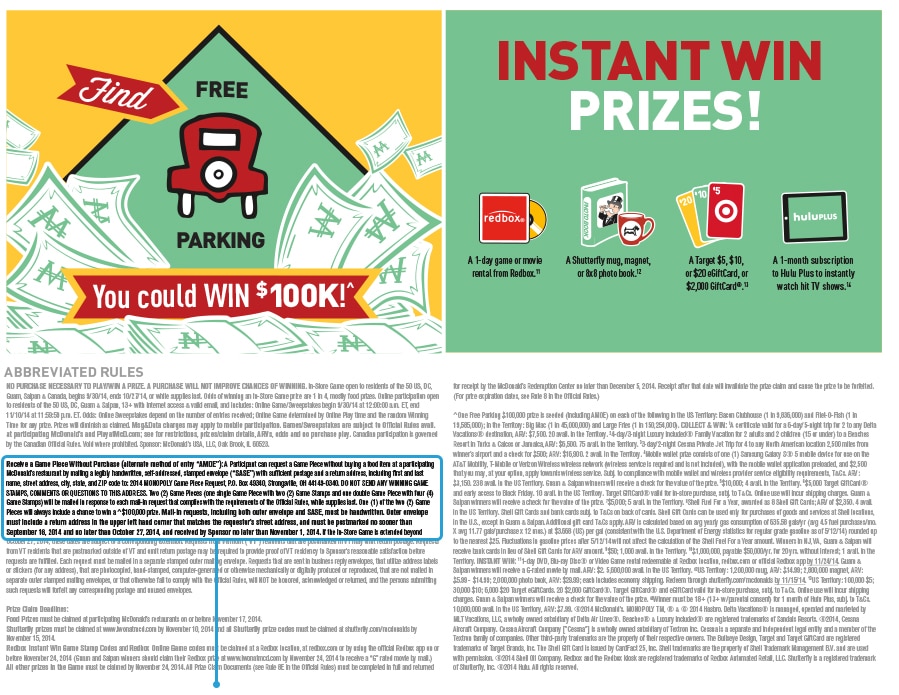 Receive a Game Piece Without Purchase (alternate method of entry “AMOE”): A Participant can request a Game Piece without buying a food item at a participating McDonald’s restaurant by mailing a legibly handwritten, self-addressed, stamped envelope (“SASE”) with sufficient postage and a return address, including first and last name, street address, city, state, and ZIP code to: 2014 MONOPOLY Game Piece Request, P.O. Box 49340, Strongsville, OH 44149-0340. DO NOT SEND ANY WINNING GAME STAMPS, COMMENTS OR QUESTIONS TO THIS ADDRESS. Two (2) Game Pieces (one single Game Piece with two (2) Game Stamps and one double Game Piece with four (4) Game Stamps) will be mailed in response to each mail-in request that complies with the requirements of the Official Rules, while supplies last. One (1) of the two (2) Game Pieces will always include a chance to win a ^$100,000 prize. Mail-in requests, including both outer envelope and SASE, must be handwritten. Outer envelope must include a return address in the upper left hand corner that matches the requestor’s street address, and must be postmarked no sooner than September 16, 2014 and no later than October 27, 2014, and received by Sponsor no later than November 1, 2014.
Major brands with large legal teams have the money and resources to find loopholes and gray area in sweepstakes laws. For your next giveaway, my recommendation is to keep it simple, and write terms and conditions that will clearly keep you within Lottery Law compliance. To help you do that, check out our Official Rules Template we’ve created that can be customized to fit your business.
Frequently Asked Questions
Do I really need "no purchase necessary" on my giveaway? Yes, if winners are picked by chance and you're running it in the U.S. A chance-based giveaway that requires a purchase is an illegal lottery under federal and state law.
What's the difference between a sweepstakes, a contest, a lottery, and a raffle? Sweepstakes pick winners at random and must be free to enter. Contests pick winners by skill. Lotteries are run only by governments, and raffles generally only by nonprofits.
Can I give purchasers bonus entries? Only if free entrants can get the same number of entries without buying. A purchase can't improve anyone's odds.
Does this apply to small businesses? Yes. Lottery laws apply to every business, from a local shop to a national brand.
Can I ask people to like, follow, or comment to enter? Generally yes. Those actions usually aren't treated as consideration. Just follow each platform's promotion rules.
Do I need to register my giveaway? Only in some cases. New York and Florida require registration and bonding when total prizes exceed $5,000 and their residents can enter.
What's the easiest way to stay compliant? Keep entry free, publish clear official rules, and start from our Free Rules Generator. For big prizes, have an attorney review your rules.
Ready to run your first giveaway? Start free with ShortStack.
Resources Referenced: